Thursday, February 10, 2011

Tech Savvy Advice

Parents, teachers, librarians, and students—we all use modern technology on a daily basis. There are so many options for its uses, such as homework, research, social media, and games. The classroom and library have become hubs for technology geared to kids and teens.
In March, YALSA is celebrating their 5th Teen Tech Week. According to their site, "Teen Tech Week is a national initiative aimed at teens, librarians, educators, parents, and other concerned adults that highlights nonprint resources at the library." The 2011 theme is Mix and Mash @ your library, which will focus on "encouraging teens to use library resources to express their creativity by developing their own unique online content and safely sharing it by using online collaborative tools." http://www.ala.org/ala/mgrps/divs/yalsa/teentechweek/ttw11/home11.cfm

The books in this month's tech feature focus books focus on technology—its history, its "rules," and its many uses. http://www.childrenslit.com/childrenslit/th_technology.html


The Internet and the World Wide Web
Sean Connolly
Use of the internet and the web are so prevalent in present day society that it is hard to remember that as recently as twenty years ago hardly anyone was familiar with terms such as download, web site, or e-mail. The technology has advanced so quickly that, in many cases, young people use the internet and web with more ease than the adults who are interacting with them. The possibilities and promises in this technology are great, but there can be risks involved in their use. Beginning with the development of computers and continuing through the extensive and sophisticated uses of the internet and web sites, the book presents an overview of this modern media phenomenon. Some of the risks discussed include the possibility of accessing incorrect or misleading information on web sites, the dangers of revealing personal information to strangers, and identify theft. Lists of suggestions for Netiquette and Safe Use of the Internet are included. Predictions for the future of these media are left open. Appropriate full-color photographs aid in understanding. Questions and activities designed to engage the reader appear in boxes throughout the text. Includes a glossary, bibliography, list of websites, and an index. A good choice for middle grade research. Part of the "Getting the Message" series. 2010, Smart Apple Media, $34.25. Ages 10 to 14. Reviewer: Phyllis Kennemer, Ph.D. (Children's Literature).
ISBN: 9781599203478

Tuesday, February 1, 2011

ANY QUESTIONS?: HOW STORIES GROW by Jacqueline Jules

ANY QUESTIONS?: HOW STORIES GROW
by Jacqueline Jules

Any questions? This portion of my school visits is my favorite part—and NOT because it usually comes at the end. I like to answer questions because they provide the answer to the question authors are most frequently asked. Where do you get your ideas?

My stories all grow out of questions. For example, when I sat down to write my picture book No English, I began with the question, “Can two people who don’t speak the same language become friends?” From there I continued with other questions. “Can you imagine what it’s like to be surrounded by people you don’t understand?” By posing and answering one question after another, I crafted a story about two second grade girls who found a creative way to overcome a language barrier.

For my chapter book series, Zapato Power, I began with a question I love discussing with students. If you could have one superpower, what would it be? Would you want super strength? Would you like to be invisible? How about super hearing or super eyesight? The possibilities were endless, and the more I considered the question, the more fun I had.

After much thought, I decided that my character of Freddie Ramos in Zapato Power: Freddie Ramos Takes Off, would receive a mysterious box filled with super-powered purple sneakers. These shoes would give him the ability to run faster than a metro train. But my questions did not stop there. Who gave Freddie the shoes? How would Freddie use his special sneakers? Would it be easy for him to become a superhero? Where would he find superhero jobs at elementary school?

To write the sequels, Zapato Power: Freddie Ramos Springs into Action and Zapato Power: Freddie Ramos Zooms to the Rescue, I also asked myself questions. What other mysteries could Freddie solve? What problems should he overcome? I have discussed these questions with students at schools, and their intriguing answers often ignite my imagination.

Questions are the fuel for my stories. Not only do they help me create, they help me revise. When I look over my first drafts, I have to ask myself questions, too. Did I make this scene clear enough for the reader? Should I give the reader more clues before the mystery is solved? Did I say anything that might confuse my reader?

I hope that after my school visits, my audiences will be ready to go back to their own writing notebooks and pose question after question until their imaginations are racing as fast as Freddie Ramos in his magic purple shoes.

Thursday, January 6, 2011

Snow Snow Snow

I may be out numbered here but this time of year I am always hoping for a massive blizzard. Living in the DC area means this rarely happens—even a few inches is a big deal. I just feel that if it's going to be cold, dark, and I'm going to have dry skin, I at least want something pretty to look at and play in. Even if it does cause chaos.

For kids in school, Snow Days can be pretty magical. No school. Playing outside in the snow then curling up inside with hot chocolate and a good book. A break in routine. But, coming up with activities for kids to do, both inside and out of the house, can be a challenge. Traditional crafts, like creating snowflake chains, snowmen out of cotton balls, and playing board games are always popular. There are so many games and sports that are perfect for a snowy day—making snowmen and igloos, sledding, skiing and snowboarding. And of course, Snow Days can be a excellent opportunity to read as a family. The selections below are a mix of fiction and nonfiction and they all relate to snow. Also, check out these sites for more ideas and craft suggestions.

http://www.childrenslit.com/childrenslit/th_snow.html

http://workathomemoms.about.com/od/kidsactivitiesfamilyfun/a/snowdaytodo.htm
http://crafts.kaboose.com/holidays/seasons/winter
http://fun.families.com/blog/simple-snow-day-crafts-for-kids

Willow and the Snow Day Dance
Denise Brennan Nelson
Illustrated by Cyd Moore
The story opens with a description of Mr. Larch's lonely life and his lack of interest in his garden, his neighbors, or any seasonal activities. He even posts signs on his perfect-for-sledding-hill warning everyone to "keep off" and "go away." The cheerful watercolor illustrations portray the seasons and their decorations passing by Mr. Larch's house, known locally as "The Cave." When irrepressible Willow moves across the street from the Cave, her sunny disposition is obvious. Delighted with enough room to start a garden, Willow sends colorful letters to each of her neighbors asking for help getting started with seedlings or seeds. The response is such that her yard becomes a luscious garden that brightens the entire street and gives everyone pleasure for having shared. Willow organizes a collection of "hats and mittens" for her school's charity drive and rewards participants with vegetables from her garden. Sharp observers will notice that Mr. Larch makes a donation and receives his own share of the harvest's bounty. Willow sends letters and notes to all of the neighbors and manages to provide a shining example of how neighborliness changes everyone. Winter's approach makes Willow want to have a giant sledding event but the weather refuses to cooperate. Willow delivers yet another note: "I'm in need of snow! Can you help?" The picture of Mr. Larch reading the note shows a hint of a smile on his lips. Willow receives a response in the form of a letter with instructions for "The Snow Day Dance." She passes out copies of the instructions (which include wearing pajamas inside out and backwards AND dancing wildly on one's bed). The double spread of all of the neighbors cavorting on their beds includes Mr. Larch in one corner. Then the next morning the entire neighborhood is covered in snow and decorated with cheerful snow people and a big message made from snowballs "Snow Day." Mr. Larch stands waiting at the top of his hill, ready to lead the sledding. This title covers so many things that teachers can employ in a classroom setting that the list could read like a basic curriculum: sequences in nature, weather, seasonal activities, recycling, predicting outcomes, having faith in people is important, generosity makes everyone feel good, writing letters can change attitudes and actions, observing others can provide inspiration, being a role model is essential (and can be contagious) and so forth...all of this wrapped in appealing illustrations. 2011, Sleeping Bear Press, Ages 3 to 8, $16.95. Reviewer: Sheilah Egan (Children's Literature).
ISBN: 978-1-58536-522-7


Emily Griffin
CLCD

Wednesday, December 29, 2010

2011 SB&F Prize Winners

CLCD President Marilyn Courtot once again served on the SB&F Prize committee. The following winners were recently announced. http://www.sbfonline.com/Subaru/Pages/CurrentWinners.aspx

Children's Science Picture Book
Magic School Bus and the Climate Challenge
Oh, that all students could have an imaginative science teacher like Ms. Frizzle! The Friz loads her students into a magical bus-plane which takes them on a tour of the world. They see first-hand the causes and results of global warming. Student notebook pages are interspersed throughout the text to show their understanding of these concepts. Whimsical illustrations throughout the book show the elements of global warming and the students’ reaction to these events on this tour. Questions and answers in the back of the book address what children have read. The text is age appropriate and the humor combined with scientific facts make reading this book fun and informative. Young readers and their parents will learn how to make actionable changes that will make a difference in global warming. Although this is a stand-alone topic, it is part of the “Magic School Bus” series. 2010, Scholastic Press, $16.99. Ages 7 to 10. Reviewer: Annie Laura Smith (Children's Literature).

Middle Grades Science Book
The Hive Detectives: Chronicle of a Honey Bee Catastrophe
In 2006, a commercial beekeeper lost all the bees in 400 hundred of his hives for a total of 20 million bees. To unravel the mystery, four respected scientists began an investigation to seek the cause of the bees’ disappearance. What follows for readers is the unraveling of a mystery to match any fictional whodunit. One by one, leads are followed and discarded, but despite many theories, this mystery has yet to be solved. The book also includes the work of amateur beekeeper Mary Duane and follows her to her hives to watch her care for her bees and learn the fascinating process of extracting honey from the hive, which the author calls “liquid gold.” Along the way, readers pick up information on the social structure of the hive, physical description and division of labor of its inhabitants, and the vital role of bees in the agricultural world. Faux notebook-style pages introduce each scientist as well as provide some hive and bee information. The accompany photos, in addition to being well composed, are dramatic and colorful. An extended appendix and comprehensive glossary and index round out this highly readable and worthy science book. 2010, Houghton, $18.00. Ages 10 to 14. Reviewer: Beverley Fahey (Children's Literature).

Young Adult Science Book
The Immortal Life of Henrietta Lacks
Science journalist Skloot makes a remarkable debut with this multilayered story about “faith, science, journalism, and grace.” It is also a tale of medical wonders and medical arrogance, racism, poverty and the bond that grows, sometimes painfully, between two very different women—Skloot and Deborah Lacks—sharing an obsession to learn about Deborah’s mother, Henrietta, and her magical, immortal cells. Henrietta Lacks was a 31-year-old black mother of five in Baltimore when she died of cervical cancer in 1951. Without her knowledge, doctors treating her at Johns Hopkins took tissue samples from her cervix for research. They spawned the first viable, indeed miraculously productive, cell line—known as HeLa. These cells have aided in medical discoveries from the polio vaccine to AIDS treatments. What Skloot so poignantly portrays is the devastating impact Henrietta’s death and the eventual importance of her cells had on her husband and children. Skloot’s portraits of Deborah, her father and brothers are so vibrant and immediate they recall Adrian Nicole LeBlanc’s Random Family. Writing in plain, clear prose, Skloot avoids melodrama and makes no judgments. Letting people and events speak for themselves, Skloot tells a rich, resonant tale of modern science, the wonders it can perform and how easily it can exploit society’s most vulnerable people. Review from Publishers Weekly http://www.publishersweekly.com/pw/reviews/single/53674-the-immortal-life-of-henrietta-lacks.html

Hands-On Science Book
The Book of Potentially Catastrophic Science
Connolly starts at the beginning of human experimentation in the Stone Age and discusses the great discovery of weapons. Moving forward in history, the book explores the discovery of fire, the creation of arrows, and the wheel. Spending a chapter on each momentous change for Earth, we march past many scenes in history including the discovery that the earth is not flat; the invention of gunpowder, and nuclear explosions. The breadth of this book is amazing. Through it all, Connolly maintains a casual tone of a tour guide who assumes the reader is up to the (sometimes) complex topic. The projects, which are manageable for fairly young readers, include folding a paper helicopter, boiling water in a paper cup, and creating a chain reaction using marbles or toy cars. Each chapter is made up of a description of a particularly discovery or earth-changing experiment, an explanation of the scientific principles involved, and a short project. While the projects will be fun, they will not stand on their own as science fair projects; readers would need to come up with further questions to answer in their experiments. 2010, Workman Publishing, $13.95. Ages 9 up. Reviewer: Amy S. Hansen (Children's Literature).

Wednesday, December 15, 2010

Secrets of Stonehenge & Searching with CLCD

Last month PBS aired a new feature, Secrets of Stonehenge, about new archeological finds around Stonehenge. You can watch the full program online at http://www.pbs.org/wgbh/nova/ancient/secrets-stonehenge.html.

This educational program is a great example to show how teachers, librarians, parents, and caregivers can incorporate The Children's Literature Comprehensive Database (CLCD) with other media to present truly comprehensive information to children and young adults.

By using simple search parameters, you can find a great list of appropriate books to tie-in to the Secrets of Stonehenge TV program. I searched for "stonehenge" and changed the pubdate to "2008" on. That's it. Other suggestions for more specific searches would be to select nonfiction and change the age ranges or grade levels under "additional search qualifiers," and also to select subject headings under "search specific fields." For more on search procedures go to http://www.childrenslit.com/use_database/search_procedures.php.

From 2 million MARC records this search narrowed down the results to 24 titles. By reading the different reviews you can determine what books fit your needs best. Because CLCD has full-text searching, a simple search on Stonehenge can lead you to books that include Stonehenge but focus on a different topic. This is one of my favorite parts of using CLCD -- that it can lead you in directions that you might not have originally thought of.
 
Here are a few selected reviews from that search:

Astronomy and Culture
Edith W. Hetherington and Norriss S. Hetherington
It’s the twentieth anniversary of the Hubble telescope launching--what better time to look at astronomy books? The Greenwood Guides to the Universe seven-volume series includes The Sun, The Inner Planets, Stars and Galaxies, Asteroids, Comets, Dwarf Planets, and The Outer Planets. The writing is accessible to most high school students, and the content is interesting for the browser but includes enough depth and breadth for more serious researchers. The information is as current as possible. In addition to the standard volumes on the components of the universe, the series contains two unique volumes: Cosmology and the Evolution of the Universe and Astronomy and Culture. Astronomy and Culture examines the history of astronomy from Stonehenge to recent discoveries. There are unique and interesting chapters on mythology and astronomy, calendars, extraterrestrial life and science fiction, and astronomy and religion. This set will be used for reports and for those interested in astronomy. It is a great choice for updating your collection in this changing scientific area. (Greenwood Guides to the Universe) VOYA CODES: 5Q 2P S (Hard to imagine it being any better written; For the YA with a special interest in the subject; Senior High, defined as grades 10 to 12). 2009, Greenwood, 231p.; Glossary. Index. Illustrations. Photos. Charts. Biblio. Further Reading., $65. Ages 15 to 18. Reviewer: Susan Allen (VOYA, August 2010 (Vol. 33, No. 3)).

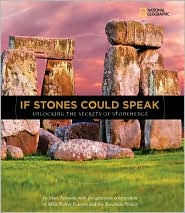
If Stones Could Speak: Unlocking the Secrets of Stonehenge
Marc Aronson
Working with chief archaeologist of the Riverside Project, Mike Parker Pearson, the author discusses the often-serendipitous nature of scientific discovery. This book does not deal with questions about how Stonehenge was built, but rather with understanding why it was built. The conventional wisdom--that it served as a temple--was turned on its head when an archaeologist from Madagascar was brought in to look at the site, and he suggested that it was a place to honor and assist the transit of the dead. Having studied a similar culture on Madagascar where the people built magnificent edifices of stone for the dead while living in humble wooden structures, Ramilisonina caused archaeologists to look at Stonehenge--and its surroundings--in a totally new way, leading to monumental discoveries of adjacent sites that fit with this new theory. The science of archaeology has advanced greatly in the last couple of decades and some of the earlier data that had been puzzling those studying Stonehenge turned out to be miscalculations by earlier scientists. Wonderful photographs of people as well as places, and abundant supplementary information in the form of chronologies, brief biographies of relevant archaeologists, and suggestions for further reading and research are plusses here. But perhaps the book’s most unique contribution are these ideas: science often advances by stops and starts; new knowledge is often as much the result of imagination and inspiration as hard detailed fact gathering; and there is always something new to learn. 2010, National Geographic Society, $17.95. Ages 7 to 14. Reviewer: Paula McMillen, Ph.D. (Children's Literature).

Stonehenge
Kate Riggs
This brief book about Stonehenge gives information about the famous circle of enormous stones located on England’s Salisbury Plain. Color photographs illustrate the area, the stones and their layout pictured at different times of day, visitors to the site, and contemporary Druid worshippers. The text points out that since the installation was completed around 3,500 years ago, the stones do not look exactly as they originally did. All have been worn down by centuries of weather, some have fallen over, and some have been taken away for use in other structures. The eighty bluestones that originally made up the inner circle were brought from the Welsh mountains, and the much larger sarcen rocks were arranged around them later. The reasons for building Stonehenge remain a mystery, though many people believe it was a place of worship. A very popular landmark, Stonehenge attracts nearly a million visitors every year. The text is followed by a four-word glossary, two suggestions for further reading, and a brief index. The book is part of the “Places of Old” series. 2009, Creative Education/The Creative Company, $24.25. Ages 6 to 9. Reviewer: Judy DaPolito (Children's Literature).
 
Emily Griffin
CLCD

Tuesday, December 7, 2010

Interview with Jim Gownley

Children's Literature reviewer Kathie Josephs interviewed Jimmy Gownley, author of the popular Amelia Rules! series. Below are excerpts from that interview. For the full feature visit http://www.childrenslit.com/childrenslit/mai_gownley_jimmy_qa.html.

Kathie Josephs: When I was growing up I lived at the library. Did you go there much?
Jimmy Gownley: No, we didn't have one and we didn't have a bookstore either. There was a library in Ashlyn and that's about 3 ½ miles from Girardville. You couldn't even ride a bike to it because it was too dangerous a route. So I never went to the library. Sometime I could go to a bookstore that was even further away, but that was in the mall. In Girardville there was a very small convenience store. When I was really little, there were some candy stores and a newsstand, but essentially when I was growing up we had only the one store and that is where I bought all the comic books, but my parents were always hugely interested in getting me to read and to read early. When I was only 3 years old, my Mom was teaching me to read. And one of the first things she read to me was Charles Schultz's, "Peanuts." My whole life I remember those things. Another way she would teach me to read was by making flash cards. It was hilarious because that was in the 1970's which I know sounds like a million years ago. She could have gone to the store to purchase them, but she made her own for some reason. She can't draw, but she made little stick figures and stuff like that. One day when I couldn't have even been four, because I know we were still living in the apartment that we moved out of when I was four, I started taping the flash cards to the door of the apartment. I was making a story out of it. Boy got in his car – drove to his house. You know, I was just a little kid and I made my first comic strip by using my Mom's flash cards. What's nice about that is whenever people ask me, "How did you ever become a cartoonist," I can say, "I blame my Mother."

KJ: There you go, a perfect answer.
JG: Our school had a library and I could take books out. I remember that I was obsessed with one called Harriet the Spy.

KJ: That is a great book! You know kids still read Harriet.
JG: Yeah! Yeah! They have made a few attempts at sequels but they are sort of sad. The original Harriet the Spy was absolutely mind blowing; I just took it out again and again. For all I knew, this was a lost, forgotten book, because I had never heard anyone mention it... ever. I couldn't find a copy to buy, so I took my notebook and I was trying to copy it so I could have a copy to read. Of course I gave that up after the first charter. There was a Scholastic Book Fair at my school and that was where I was able to buy my own copy. You know, I still have that copy today.

KJ: My next question you have already answered, because I was going to ask when you realized you wanted to be a writer. I am going to assume it was when you put the flashcards on the door.
JG: It wasn't just writing; it was being a cartoonist. That was what I wanted to be from as early as Kindergarten. There was a brief time when I thought I wanted to be Jedi Knight, but it turned out when I would stare at items across the room and try to will to come into my hand nothing happened. I went back to cartooning. In fifth grade I had a teacher named Miss Klinger, and she was the first person that said that I had writing ability. I remember very clearly. She was a very good teacher. We would read stories from our readers and there were a couple of instances when we were assigned to write sequels. And I wrote one for a story called The House of Dies Drear, but I can't remember what it was about now. It was some kind of ghost story, and when I wrote my sequel, I can remember my teacher saying, "You could be a writer someday." And she actually gave me some extra assignments to foster that talent. It was fun, and kind of weird because it was fun, but didn't count toward my grade. I was thrilled that somebody thought that I could possibly write stories.

KJ: How did you decide to have Amelia face real things in her life? Your books give good messages to young people.
JG: I think it goes back to that conversation I had with my friend Tony back in high school. My initial intention when I started writing "Amelia"...the first thing I did was write a really, really short story called "Freeze Tag". It's in the first chapter of The Whole World's Crazy. It was to be unbelievably light-hearted and nothing serious, but it just didn't feel like that was my voice and what I was best at doing. I had written a number of stories and it was more humorous than having anything serious in them.

Then the September 11th attack happened in 2001. I was having dinner with a friend named John Trogner and he said, " What are you going to do about this? In the book, how are you going to address this?" I told him I wasn't going to address it. And he said, "You have to." I wanted to know what he meant by I had to. He said, "Your audience is kids and kids will read this; they relate to Amelia and they are going to be thinking about this and it is your responsibility to write about this." And I thought, "Wow, that's farther that I ever thought I'd go."

But I wrote the Christmas story called, Amelia and the Other Side of Yuletide. Mostly it's about Amelia's trying to scam her parents. Using their divorce guilt to give her more presents. At the end of the story Amelia gives a monologue. If you read them now, it seems like she is talking about people who have difficulties and then there are people who have great difficulties and we should be grateful. At the time it was very obviously a reference of what happened because she is from New York and her dad still lived in New York. Once I did that, then all bets were off and it became a real world. Amelia had always felt like a real character to me, a real little girl.

KJ: What is the most interesting activity that you do other than writing?
JG: You know what I like to do? I like to play the guitar. I've been playing since I was in 4th grade and I don't think I have gotten any better, but I like doing it.

KJ: What is your favorite food?
JG: That's easy. Cake! I wish I could say something more sophisticated like I have developed this great pallet. Oh, escargot is wonderful, but I like cake...most any kind of cake.

KJ: What's the best movie you have ever seen?
JG: You know, when I was very little, I would have thought the best movie was the Muppet Movie, and then Star Wars, and then it would have been Annie Hall, and then Pulp Fiction and now it is the Muppet Movie again.

(photo via http://nymag.com/daily/entertainment/2008/04/comiccon_amelia_rules_creator.html)

Monday, November 29, 2010

Hanukkah Read-Alouds

Children's Literature reviewer Lois Gross shares some of her favorite read-aloud titles, appropriate for ages 4 to 7, for Hanukkah this year.

I Have a Little Dreidel
Maxie Baum
Illustrated by Julie Paschkis
(Scholastic, 2006)
Great illustrations highlight the traditional song with added lyrics. Kids can help with the chorus.

Our Eight Nights of Hanukkah
Michael Rosen
Illustrated by Anne DiSalovo-Ryan
(Holiday House, 2000)
A child describes the night-by-night events of his family's holiday.

Hanukkah Haiku
Harriet Ziefert
Illustrated by Karla Gudeon
(Blue Apple Books, 2008)
Interesting, different approach to telling the holiday story in Haiku form. Pages open to reveal a different lit candle for each night.

Lots of Latkes: A Hanukkah Story
Sandy Lanton
Illustrated by Vicki Jo Redenbaugh
(Kar Ben, 2003)
This has a nice old tale feel to it. A shtetl community comes together to celebrate the holiday. Everyone is supposed to bring one item for the holiday meal, but they all end up bringing latkes.

In the Month of Kislev: A Story for Hanukkah
Nina Jaffe
Illustrated by Louis August
This is the traditional story of paying the miserly baker for the smells of his cakes with the sound of coins. It's a little wordy, but it's a really good story.

The Hanukkah Mice
Steven Kroll
Illustrated by Michelle Shapiro
(Marshall Kavendish, 2008)
A little girl's celebration is duplicated by the mouse family living in her doll house.

Mrs. Greenberg's Messy Hanukkah
Linda Glazer
Illustrated by Nancy Cole
(Albert Whitman, 2004)
When Rachel makes latkes with her neighbor, Mrs. Greenberg, the cooking experience becomes messy fun.

My Two Holidays
Danielle Novack
Illustrated by Phyllis Harris
(Scholastic, 2010)
This really is a nice attempt to deal with the situation of dual holidays that so many families now have.

Just Enough is Plenty
Barbara Goldin
This is an Elijah tale for Hanukkah. Actually, I'd recommend anything by Barbara Goldin. She is a storyteller and has a storyteller's ear for how the story should flow.

The Best Hanukkah Ever
Barbara Goldin
Illustrated by Avi Katz
A story about how the gift itself doesn't matter; it's getting the right gift for the right person that counts.

Trees of the Dancing Goats
Patricia Palocco
(Simon and Schuster, 1996)
A Jewish family in Michigan helps to make Christmas special for sick neighbors creating their own Christmas miracle.

Thursday, November 18, 2010

Themed Reviews: Thanksgiving

Thanksgiving is one week away. Browse through our Thanksgiving feature and those from previous years for selections to share with your students, family, and friends. http://www.childrenslit.com/childrenslit/th_thanksgiving.html


The First Thanksgiving: A Lift-the-Flap Book
Nancy Davis
Thanksgiving sometimes is a challenge when planning story time for little ones. Either you find books on the imminent death of the turkey (who then, humorously, becomes the guest of honor), or newly illustrated versions of Over the River and Through the Woods. This sweetly done board books with lift-the-flaps is a nice addition to a Thanksgiving holiday collection. Told in the manner of The House that Jack Built, the rhyme and pictures follow the round-faced pilgrims from England to the New Land where they are befriended and educated by the natives, set about planting crops, and celebrate with a banquet to which they invite their new friends. The pilgrims are all rosy cheeked and blonde. The native people are rosy-cheeked and brown-skinned. The pictures are easily talked about as the flaps reveal enterprising Pilgrims companionably fishing with the Indians, spinning, planting, and eating. The Thanksgiving dinner shows both groups of people share a celebratory meal. In addition to the obvious lesson about the Pilgrims settlement of the Massachusetts colony, this book can be expanded to lessons on cooperation, sharing, and helping our neighbors. Kids will ask for repeat readings so that they can manipulate the pages. 2010, Simon and Schuster Children’s Division, Ages 1 to 4, $5.99. Reviewer: Lois Rubin Gross (Children’s Literature).
ISBN: 978-1-4424-0807-4

Why Did the Pilgrims Come to the New World?
Laura Hamilton Waxman
In the 1600s Puritans and Separatists broke with the Anglican Church and sought relief from persecution first in Holland and then in the New World. After a perilous voyage on the Mayflower, they arrived at what is now called Plymouth on Cape Cod. Before settling in they drew up and signed the Mayflower Compact on the ship. The signers were not a homogeneous group, nor were they all members of religious sects.. All agreed to stay, work together, and treat each other fairly. Many died that first winter. Samoset and Squanto, Native Americans who spoke English, helped them. The first harvest in 1621 led to a feast which became Thanksgiving. A question at the end of each chapter leads into the next chapter. Unusual words appear in boxes with a line leading to the margin where the word is defined. Sidebars pictured on notebook paper answer further questions with information such as “The word pilgrim refers to a person who travels to a sacred place for a religious purpose.” Colored photographs, maps, and reproductions of famous paintings enhance the text. This is one of the “Six Questions of American History” series. There is a timeline, source notes, bibliography, list for further reading and web sites, and an index. This interesting account for young people explains the various controversies surrounding the Mayflower voyage and explains how they were overcome. 2011, Lerner Publications Company/Lerner Publishing Group, Ages 12 to 18, $29.27. Reviewer: Carlee Hallman (Children’s Literature).
ISBN: 978-1-5801-3665-5

Monday, November 8, 2010

Themed Reviews: Veterans Day

On November 11, 1918 an armistice between Allied Forces and Germany was signed, ending World War I after four years of fighting. The armistice ended hostilities at the 11th hour of the 11th day of the 11th month of 1918. The following year U.S. President Woodrow Wilson issued the first Armistice Day proclamation:

To us in America, the reflections of Armistice Day will be filled with solemn pride in the heroism of those who died in the country's service and with gratitude for the victory, both because of the thing from which it has freed us and because of the opportunity it has given America to show her sympathy with peace and justice in the councils of the nations.

On Armistice Day in 1921, an unidentified American soldier killed in WWI was buried in a special tomb in Arlington National Cemetery; now know as the Tomb of the Unknown Soldier. It is guarded 24 hours a day, 365 days a year by members of The Old Guard and located near the center of the cemetery.

Armistice Day was declared a Federal holiday in 1938. Celebrations honoring WWI veterans continued to include parades, public gatherings, and moments of silence.

After World War II and the Korean War, veteran service organizations lobbied congress to amend the 1938 act—changing the word “Armistice” to “Veterans.” This new legislation was signed by President Dwight D. Eisenhower on June 1, 1954. Since November 11, 1954 the U.S. has honored American veterans, living or dead, of all wars on Veterans Day.

The following recently published books are about Veterans Day, wars involving American soldiers, or the impact veterans have on their friends and family. Browse through this feature and those from previous years to discover more. http://www.childrenslit.com/childrenslit/th_veteransday.html

The War to End All Wars: World War I
Russell Freedman
The clearest and most comprehensible book about World War I also delivers a strong anti-war message. Freedman presents the political and social temperaments of 1914 and the naiveté of European leaders and ordinary citizens that led to the war frenzy. He then takes the reader through all aspects of this war that was presumed at the very beginning to be short-lived. Well-selected photographs personalize the events. Along with the text they show life in the trenches and the death and destruction caused by the use of the new military technologies. The futility of war resonates as Freedman recounts the famous battles of Verdun and the Somme. The changing climate of the war is seen through the sinking of the Lusitania, the war at sea, the Russian Revolution, and the entry of the United States. The last chapter, titled “Losing the Peace” recounts stunning human losses. Freedman correlates the poorly-drawn peace agreement to discord in the Middle East and resentments in Germany, which led to World War II and to today’s wars and unrest. Freedman has a singular ability to get to the core of the issue and present it with compelling storytelling. Through his careful and exhaustive research, Freedman selects just the right quotes, and weaves them seamlessly into the text. For a wide range of reasons, this is a book every young person needs to read. Source notes, bibliography, picture credits and an index complete the book. 2010, Clarion Books/Houghton Mifflin Harcourt, Ages 10 to 14, $22.00. Reviewer: Sharon Salluzzo (Children’s Literature).
ISBN: 978-0-547-02686-2

Monday, November 1, 2010

In time for the holidays...

Children's Literature provides support for book sales at numerous author events, school book fairs and the like. Often we have one or two copies of a book left that we do not bother to return to the publisher. Our stock has grown and we would like to make some very good, never used books available on a first come first serve basis at a very attractive price: 50% off list with FREE SHIPPING until December 24th.

We have four brand new forms for you to browse:
• Board Book Titles
• Picture Book Titles
• Middle Grade Titles
• Young Adult Titles

How to Place Your Order:
Print a copy of the order form and mark it up with your choices. Then fax the completed order form to (301) 469-2071 or put it in an envelope and send it to Children's Literature at the following address:
Children's Literature
7513 Shadywood Rd
Bethesda MD 20817

Orders will be filled as they are received. For credit card purchases, we will confirm your total before processing your card. If you want to use a personal or business check for a purchase, circle check as as the payment option and we will get back to you with the amount due. We will ship the books when your check arrives. If you are an institution using a purchase order, we will fill your order and send an invoice with the books.

For further information visit: http://www.childrenslit.com/childrenslit/web-booksales.html